

The right tool for the right task:
Stereomicroscope: for handling and monitoring cultures.
The stereomicroscope, also called a binocular, is the indispensable basic tool. Given the size of spores and hyphae, it is necessary to work under the stereomicroscope. Most of the time, a magnification of 20X is used, but a magnification around 40X or higher is often appreciated to clarify certain observations. It is used for:
- Single-spore or bulk inoculation
- Monitoring and observation of cultures
- Preparing samples on slides
- Delicate or precise manipulations
The model used on this site is an Olympus SZ61 mounted on the Olympus SZX2-ILLTQ base, into which the optional dark field (SZX2-CDF) and bright field (SZX2-CBF) illumination modules are inserted. The product sheet is available on the Olympus website. An EP50 camera is installed, complemented by a SCHOTT EasyLED Ring Light 600.200 for incident lighting.
A light base offering dark field is strongly recommended. This base greatly improves contrast, making it easier to detect hyphae. In the absence of dark field, oblique lighting with a lamp can probably be a reasonable alternative. See the Lightning Methods section for more details.


The upright microscope
The upright microscope is essential for fine observations and for identifying spores. It is used for:
- Observation and photography of spores on slide and coverslip
- Observation of roots
- Observation of hyphae and spores
- Monitoring culture progress
- Observation of cytoplasmic streaming in living hyphae
The upright microscope used on this site is the Olympus CX43 equipped with a trinocular tube for the camera.

Observing Petri dishes under the upright microscope is done by gently flipping the dish onto the stage. Temporarily seal the irrigation openings to prevent vermiculite, polymer, or liquid from falling onto the stage or the condenser.

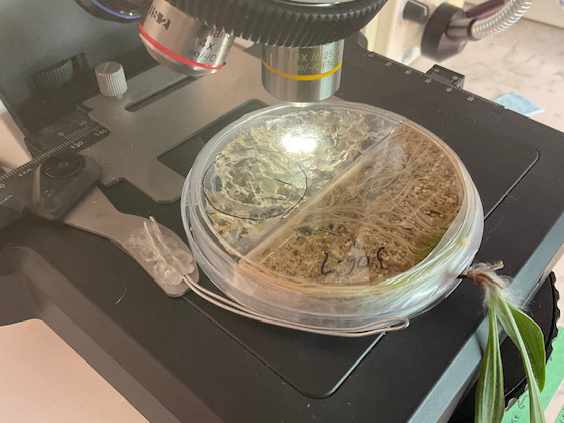
Observations are usually made through the plastic of the dish bottom. The 10X and 20X lenses, whose working distance is sufficient, can be used directly. The “Observation Methods” section explains how to use 40X, 60X, and 100X immersion lenses in this context.
The inverted microscope
The inverted microscope can be used for the same purposes as the upright microscope, namely:
- Observation and photography of spores on slide and coverslip
- Observation of roots
- Observation of hyphae and spores
- Monitoring culture progress
- Observation of cytoplasmic streaming in living hyphae
Advantages/disadvantages of the inverted microscope compared to the upright microscope:
Advantages: The Petri dish is observed directly without being flipped, which eliminates any disturbance of the medium. No preparation is required: simply place the dish on the stage and observe immediately. Standard lenses (4X, 10X, 20X, and 40X) allow excellent observations to be made.
Disadvantage: The common lenses of the inverted microscope require a long working distance and therefore have a lower numerical aperture (NA), which reduces resolution compared to equivalent lenses on an upright microscope. The usual magnification does not exceed 40X.
I use an Olympus CKX53 inverted microscope with a camera permanently attached.
The inverted microscope used on this site is the Olympus CKX53 equipped with a trinocular tube for the camera.

Lenses for the upright microscope
Consult experts before choosing your lenses. The available range is very wide and prices vary considerably. The lenses supplied by default generally allow excellent observations. For scientific publications or high-quality videos, however, investing in specific lenses may be worthwhile.
For visual monitoring and observations without taking measurements.
The default lenses are generally sufficient. Combined with 10X eyepieces, the 10X and 20X lenses give magnifications of 100X and 200X — amply sufficient for monitoring cultures.
For photography and video, the choice between basic and apochromatic lenses depends on the quality required and the budget. Remember that sample preparation is at least as important as lens quality. 100X immersion lenses are mainly used for studying structures mounted on coverslips. Apochromatic lenses offer an advantage especially with significant digital magnification, as illustrated by the following photos.
For detailed observations, measurements, and photography
Favor good-quality “Plan” objectives. 40X and 60X lenses allow excellent photos; 100X lenses are rarely necessary. The final image quality always results from the lens + camera combination: a good camera is just as important as good lenses.
Long working distance:
To observe through the plastic of the Petri dish and reach the hyphae deep within the polymer, 40X lenses and higher must have a long working distance. This constraint, however, reduces the numerical aperture and therefore the resolution — a trade-off to be carefully weighed depending on the intended use: observation on coverslips or through a Petri dish.
Apochromatic Lenses $$$
These lenses are ideal for high-definition photography at high magnification. To the naked eye through the eyepiece, the difference between an achromatic and an apochromatic lens is not very noticeable. It is when digitally zooming into photos that the advantage becomes clearly visible, as illustrated by the following two photos of the same hypha.


What to think of Chinese lenses on AliExpress?
Chinese manufacturers produce objectives ranging from excellent to mediocre, often at low prices on AliExpress. The difficulty lies in identifying good suppliers — and I do not have precise references on this matter. The objective shown below, sold by Olympus but made in China, is of excellent quality, but its price was not particularly low.
